


The primary half of the yr has left buyers with many questions on the trail forward for the financial system and markets. Sadly, there haven’t been many concrete solutions. Tariff bulletins and commerce negotiations have commanded the room. Then there may be the funds invoice, which incorporates tax and spending cuts. It’s additionally being negotiated at a time when issues concerning the nation’s deficit have grown, given Moody’s downgrade of the U.S. authorities’s credit standing. Final however actually not least, the Fed has but to decrease charges this yr.
Turning to the markets, we noticed fairness markets rally to start out the yr—after which dump 20 p.c, led by the leaders of the previous a number of years (i.e., the Magnificent Seven). Simply when issues reached their peak, the markets rallied greater than 20 p.c. Whereas additionally unstable, 10-year Treasury yields started the yr at 4.5 p.c however stay in about the identical place now.
Given this backdrop, the important thing query stays: the place will the financial system and markets go from right here?
The Financial system: Can It Energy By?
The reply to the place markets might go relies on the trail of the financial system. And that path hinges on whether or not the weak, survey-based financial knowledge finally impacts the laborious, measurable financial knowledge or whether or not the financial system can proceed to energy by means of varied obstacles.
Development Drivers
Assessing the potential positives for the financial system, there are three areas to contemplate.
Labor Market. The labor market is a very powerful piece of financial knowledge. Customers make up roughly 70 p.c of the financial system. In the event that they proceed to have jobs, they’re prone to spend cash. Whereas job development has softened this yr (see chart beneath), it stays in constructive territory regardless of the headwinds from federal authorities worker layoffs and immigration coverage.
Supply: The Each day Shot, June 9, 2025
Commerce offers. To really feel comfy making spending choices, shoppers and enterprise executives have to see progress on commerce offers that completely decrease or remove carried out tariffs. Whereas the worst-case situation for tariffs has been mitigated, they continue to be at a degree (15 p.c to twenty p.c) that’s greater than we’ve seen in nearly 100 years.
Finances invoice. Progress on the funds reconciliation invoice will likely be necessary for the financial outlook within the second half. Within the model of the invoice handed by the Home of Representatives, the stimulative measures for the financial system would unroll earlier than drags from spending cuts occurred within the out years. Certainly, this stimulus will likely be wanted to assist offset the affect of tariffs at the moment being felt.
The Dangers
Tariffs. The priority for financial development within the again half of the yr is that the on-again, off-again tariff implementation has already set in movement a collection of occasions that can stress the financial system. The idea is that this affect has not but been captured within the backward-looking laborious knowledge that has been reported to this point.
Client and govt sentiment. Right here, we’re seeing weakening attributable to issues about tariffs. Customers may dial again their spending and enhance financial savings attributable to greater costs and worries about job safety. Executives may delay making long-term choices about capital initiatives and hiring with out readability on international commerce. These pauses, in the event that they happen, would doubtless trigger the financial system to weaken within the second half of the yr.
Charges and spending. The impacts of tariffs and international provide chains, the funds invoice’s impact on the deficit, and the Fed remaining on maintain have all precipitated issues for U.S. Treasury bond buyers. Greater charges have an effect on borrowing prices for shoppers and will additional weigh on spending.
The Markets: Extra Volatility Forward?
After plummeting post-Liberation Day, U.S. fairness markets have climbed greater on hopes that pauses on tariffs will result in commerce offers, making any financial affect short-lived. On the similar time, the funding panorama has broadened this yr, with worldwide equities outperforming by a large margin.
Mounted earnings has additionally had a rollercoaster of a primary half. However for all of the issues and headlines, the yield on the U.S. 10-12 months Treasury bond has stayed round 4.5 p.c (plus or minus) for a lot of the yr.
Valuations. On the floor, the S&P 500 will not be low cost, however that is masked by the focus of the largest holdings. After two years the place these shares led the market greater as a result of that they had the perfect development tales, this has been a yr the place the remainder of the market has come into focus. The disparity in valuations between these two teams might be seen right here:

Supply: FactSet, Normal & Poor’s, J.P. Morgan Asset Administration. The highest 10 S&P 500 corporations are based mostly on the ten largest index constituents originally of every quarter. As of 5/31/2025, the highest 10 corporations within the index had been MSFT (6.8%), NVDA (6.6%), AAPL (6.0%), AMZN (3.9%), GOOGL/GOOG (3.6%), META (2.8%), AVGO (2.3%), TSLA (1.9%), BRK.B (1.8%), and JPM (1.5%). The remaining shares signify the remainder of the 492 corporations within the S&P 500. Information to the Markets – U.S. Knowledge as of June 6, 2025.
That disparity in valuations for various components of the market ought to result in continued investor curiosity in a broadened portfolio throughout asset courses, geographies, kinds, and sectors.
Earnings. For buyers to have faith in valuations, they have to imagine that company America can proceed to generate earnings development. Executives have actually seen financial headlines: anticipated annual earnings development for the S&P 500 has declined from 15 p.c within the fourth quarter of 2024 to 9 p.c at the moment. That stated, given all of the headwinds, if that degree of earnings development might be achieved with a greater outlook going into 2026, it ought to present a fairly constructive backdrop for buyers.
Rates of interest. Whereas the Fed appears content material to attend and see how the noise will affect the financial indicators, bond buyers haven’t hesitated to specific their views. These views have been large, as bond yields plummeted on issues a couple of international recession after which rose on beliefs that the “bond vigilantes” had been returning to specific their frustrations concerning the present path of fiscal coverage.
At instances like these, it is very important step again and take a look at charges by means of a longer-term lens. This chart reveals that present charges are in a variety they’ve been in over the previous two years.
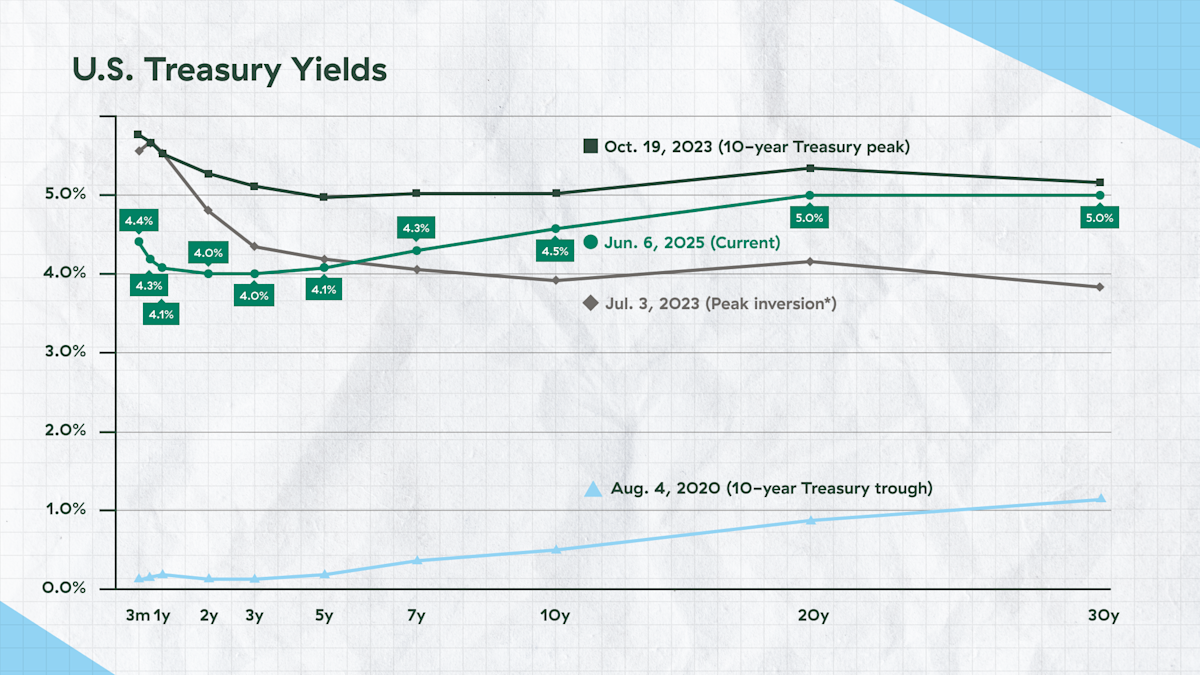
Supply: FactSet, Federal Reserve, J.P. Morgan Asset Administration. Evaluation references knowledge again to 2020. *Peak inversion is measured by the unfold between the yield on a 10-year Treasury and 2-year Treasury. Information to the Markets – U.S. Knowledge as of June 6, 2025.
Charges at present ranges create alternatives for savers and retirees on the lookout for earnings. However issues concerning the affect of tariffs on inflation and the deficit counsel that diversification throughout durations is an efficient technique for the fastened earnings portion of a portfolio.
Look to the Knowledge for Solutions
Headlines are prone to proceed to drive short-term actions in each the fairness and glued earnings markets over the stability of the yr. However it’s the financial knowledge that can inform us the last word story of how the yr will unfold.
There isn’t a doubt that commerce coverage has examined the resiliency of the U.S. financial system to this point this yr. Nonetheless, the financial system has proven energy. Excluding the affect of web exports on Q1’s barely unfavourable GDP report, the underlying financial system continued to develop. The momentum that the U.S. financial system had coming into the yr has persevered all through the headwinds.
Barring additional unexpected shocks, we anticipate that the U.S. financial system will proceed to develop slowly within the again half of the yr, which ought to assist earnings development. Volatility is prone to proceed, however the April fairness market lows priced in a good quantity of dangerous information on commerce, financial development, and earnings.
Diversification has been the important thing to weathering the headlines up to now, and we proceed to imagine that’s the easiest way to place portfolios as we enter the second half of the yr.
What’s forward for equities? Discover out in tomorrow’s Midyear Outlook submit from Rob Swanke, senior funding analysis analyst.

