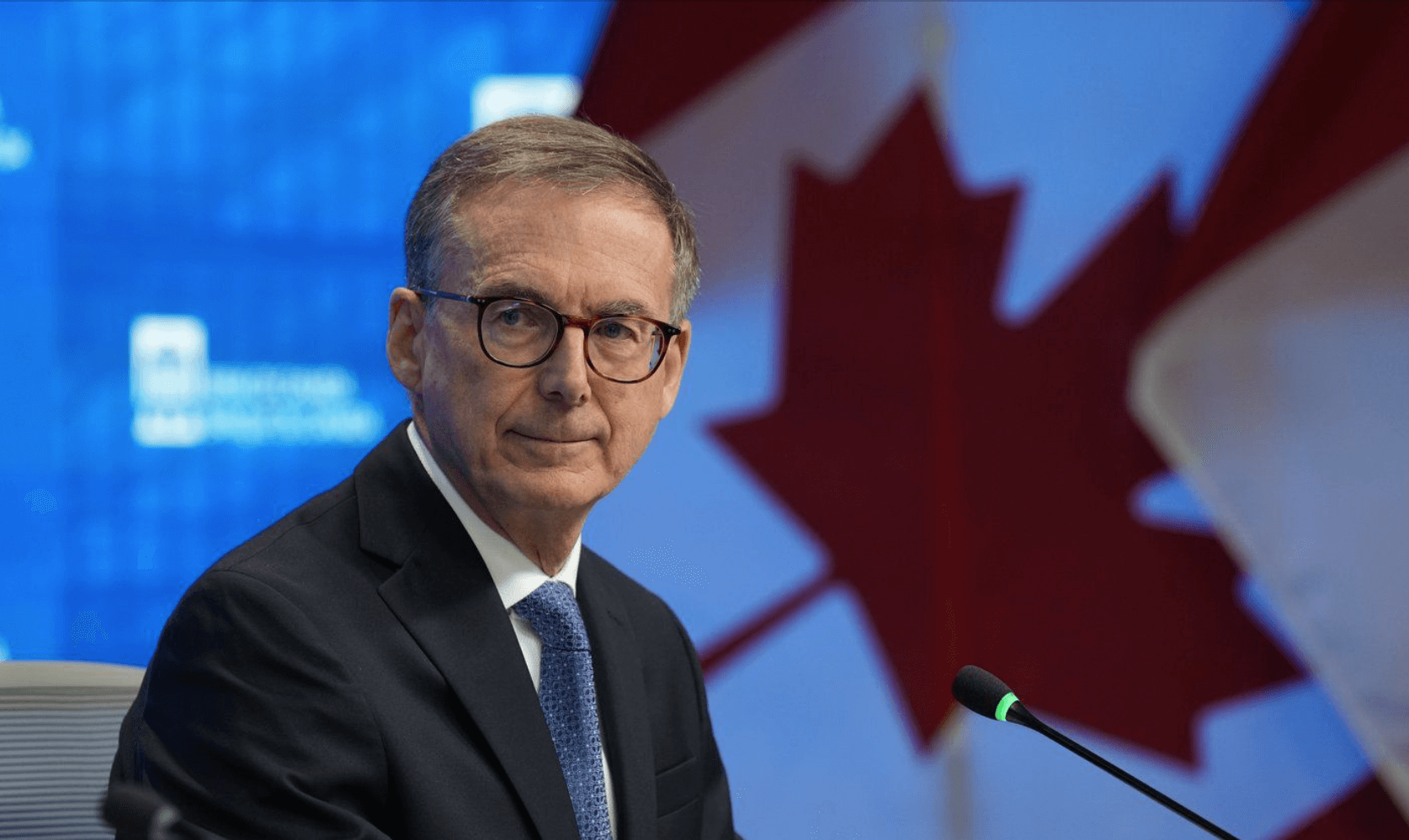
Governor Tiff Macklem stated the dangers have shifted for the reason that financial institution’s final rate of interest resolution in July. Cracks within the labour market and a pointy drop in exports are threatening development, he stated, whereas earlier indicators of underlying inflation stress are fading. “With a weaker economic system and fewer upside danger to inflation, governing council judged {that a} discount within the coverage fee was applicable to raised stability the dangers,” he instructed reporters after the speed resolution Wednesday.
The Financial institution of Canada signalled it should preserve trying over a shorter horizon than typical because it tries to set financial coverage in a consistently shifting setting. Macklem stated the financial institution is able to modify its coverage fee once more if warranted. “We’ve demonstrated as we speak, if the dangers tilt, if the dangers shift, we’re ready to take motion,” he stated. “And if the dangers tilt additional, we’re ready to take extra motion. However we’re going to take it one assembly at a time.”
Macklem forecasts modest development regardless of rising unemployment and shrinking economic system
Macklem stated a number of the stickiness in underlying inflation that was worrying the Financial institution of Canada earlier this 12 months now seems to be diminishing. The federal authorities’s resolution to drop most retaliatory tariffs in opposition to the USA firstly of this month can even take some gas out of worth development, he stated. Counter-tariff impacts have been most noticeable in meals in latest months, Macklem stated, however with the removing of these measures, costs ought to fall again in affected areas going ahead.
Canada’s jobless fee has in the meantime moved as much as 7.1% and the economic system shrank within the second quarter as U.S. tariffs took full impact. Macklem reiterated that the central financial institution doesn’t at the moment have a recession baked into its outlook, calling as an alternative for modest development of roughly 1% within the second half of the 12 months. “It’s not going to really feel good. It’s development, but it surely’s gradual development,” he stated.
You’re 2 minutes away from getting the perfect mortgage charges.
Reply a couple of fast inquiries to get a personalised quote, whether or not you’re shopping for, renewing or refinancing.
RBC economist questions fee lower, citing robust client spending
Whereas the choice to decrease the coverage fee was extensively anticipated by economists—and got here from a consensus of the central financial institution’s governing council—not all forecasters have been in favour of the lower. Nathan Janzen, assistant chief economist at RBC, stated Wednesday’s resolution was going to be a “shut name” however he’s not satisfied the economic system wanted rate-cut stimulus. Client spending is holding up and will push inflation larger going ahead, he argued.
In the meantime, financial weak spot continues to be largely concentrated in trade-exposed sectors—an area for governments to assist, not the central financial institution. “There’s most likely a greater coverage response than adjustments in rates of interest,” Janzen stated.
Macklem acknowledged that he believes fiscal coverage is healthier suited to deal with the sector-specific impacts of U.S. tariffs, whereas the Financial institution of Canada’s rate of interest can easy the broader hit from the following shifts within the economic system. “Financial coverage can’t undo the results of tariffs. Probably the most it could actually do is attempt to assist the economic system modify at a macro degree whereas conserving inflation nicely managed,” he stated.
Subsequent fee resolution comes forward of federal fall price range
The Financial institution of Canada’s subsequent fee resolution will come earlier than the federal authorities’s long-awaited fall price range, which Finance Minister François-Philippe Champagne introduced Tuesday would come on Nov. 4.
Article Continues Beneath Commercial
X
Macklem largely dismissed reporter questions Wednesday about whether or not the shortage of fiscal readability was affecting the Financial institution of Canada’s selections. He stated authorities spending plans have been only one enter into the central financial institution’s forecasts, and financial policymakers would modify their fashions after the price range is tabled.
Janzen stated that whereas RBC wasn’t calling for a fee lower this month, at 2.5% the coverage fee is simply barely under the center of the central financial institution’s estimated “impartial vary”—the place it’s neither boosting nor proscribing financial development. “It’s not aggressively stimulating the economic system. It’s nonetheless akin to easing your foot off the brakes reasonably than stepping on the fuel from a financial coverage perspective,” he stated.
Whereas there are nonetheless a variety of unknowns tied to U.S. tariffs and the worldwide commerce disruption, Macklem stated “near-term uncertainty could have come down a little bit.” If the tariff state of affairs with the USA stays regular, he stated the central financial institution will probably return to publishing a single, central forecast for the economic system at its subsequent financial coverage resolution on Oct. 29.
Economists anticipate extra fee cuts, however future strikes depend upon incoming knowledge
CIBC senior economist Katherine Decide stated in a notice to purchasers Wednesday that the economic system is “shedding resilience” and inflation ought to stay nicely contained shifting ahead. She argued that may set the central financial institution up for one more lower at its October resolution.
Monetary markets have been inserting odds of one other quarter-point lower subsequent month at simply over 40% as of Wednesday afternoon, in line with LSEG Knowledge & Analytics.
Janzen stated it might be uncommon for a central financial institution to both lower or hike its coverage fee simply as soon as, and RBC is now additionally anticipating further fee cuts to observe. However he cautioned that the Financial institution of Canada continues to be “ultra-focused” on near-term indicators, so incoming knowledge on inflation, the labour market and worldwide commerce may sway the central financial institution again to a maintain within the coming weeks. Financial policymakers will probably be taking a look at how export exercise evolves and whether or not prices from the commerce disruption are handed on to customers because it gauges the place to take the coverage fee subsequent.
Get free MoneySense monetary suggestions, information & recommendation in your inbox.
Learn extra information: