


When you’re balancing VTI vs. VOO, you’re in all probability placing cash into an index fund. That’s usually going to be a great choice. Index funds can help you diversify your portfolio even in case you don’t have a lot to speculate, and even funding professionals typically fail to select shares that beat the index efficiency.
However which of those funds do you have to select? Let’s begin with the fundamentals.
VTI vs VOO: By the Numbers
| VTI | FLIGHT | |
|---|---|---|
| Full Title | Vanguard Complete Inventory Market ETF | Vanguard S&P 500 ETF |
| Index Tracked | CRSP U.S. Complete Market Index | S&P 500 Index |
| Belongings Below Administration* | $318.6 billion | $339.7 billion |
| Variety of Holdings | 3839 | 507 |
| Expense Ratio | 0.03% | 0.03% |
| Dividend Yield* | 1.54% | 1.56% |
| Issuer | Vanguard | Vanguard |
* As of Sept. 2023
5-Yr Efficiency
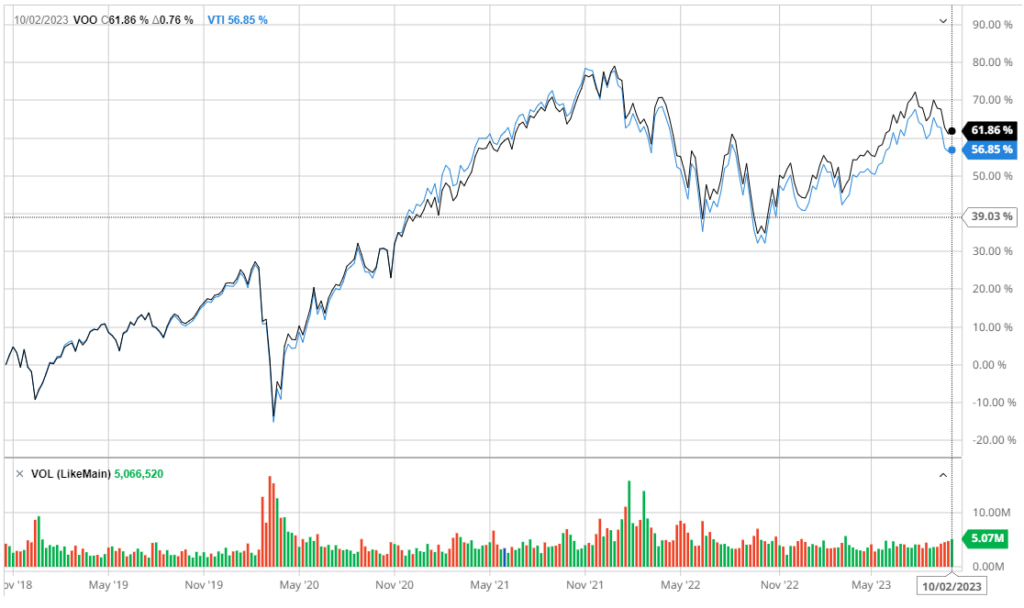
Supply: Barchat
VTI vs VOO: What’s the Distinction?
Crucial distinction between VTI and VOO is that every fund tracks a distinct index:
- VTI tracks the CRSP U.S. Complete Market index. The CRSP U.S. Complete Market index is an index of virtually 4000 firms headquartered within the US, from mega to micro capitalization. This makes the index a great illustration of your complete US inventory market, not simply the most important firms.
- FLIGHT tracks the S&P 500. The S&P 500 is an index of the five hundred high largest firms within the US.
These indices and the ETFs that monitor them are market cap weighted. That signifies that they provide bigger firms a heavier weight.
📈 Study extra: Unlock the fundamentals of constructing wealth with our step-by-step investing information for rookies.
VTI vs VOO: Sector Publicity
VTI and VOO use barely totally different phrases to interrupt down their sector publicity.
VTI Sector Breakdown
| Sector | Weight |
|---|---|
| Info Expertise | 30.20% |
| Client Discretionary | 14.40% |
| Industrials | 13.00% |
| Well being Care | 12.60% |
| Financials | 10.30% |
| Client Staples | 5.10% |
| Vitality | 4.60% |
| Actual Property | 2.90% |
| Utilities | 2.70% |
| Telecommunication | 2.20% |
| Fundamental Supplies | 2.00% |
VOO Sector Breakdown
| Sector | Weight |
|---|---|
| Expertise | 28.20% |
| Well being Care | 13.20% |
| Financials | 12.40% |
| Client Discretionary | 10.60% |
| Communication Providers | 8.80% |
| Industrials | 8.40% |
| Client Staples | 6.60% |
| Vitality | 4.40% |
| Actual Property | 2.50% |
| Fundamental Supplies | 2.50% |
| Utilities | 2.40% |
One factor that instantly stands out in these breakdowns is that each VTI and VOO are closely weighted towards IT (tech & communication) particularly VOO, reflecting the present massive market capitalization of those sectors within the US inventory market.
- VTI tracks a bigger variety of firms from a wider vary of company sizes. It’s weighted extra closely towards the buyer and industrial sectors, which comprise extra medium and small-size firms. The bigger variety of holdings and better variation within the firms’ profiles make it extra diversified.
- FLIGHT tracks a smaller variety of firms with a barely better focus in tech. It provides the next half to healthcare and financials, which are usually dominated by massive firms (typically known as Huge Banks and Huge Pharma).
Neither of those choices is basically higher or worse. They supply publicity to barely totally different sectors of the market, and that may result in totally different efficiency traits.
VTI vs VOO: The Similarities
VTI and VOO have so much in frequent. They’re each extraordinarily massive ETFs. Each funds are managed by Vanguard, which has a popularity for offering low-cost funds.
When you’re on the lookout for massive, extremely liquid funds with credible administration, each of those ETFs will go your display.
There are additionally much less apparent similarities, explaining the very comparable efficiency charts stemming from three fundamental details.
- As market cap-weighted indexes, they each give a predominant area to mega-caps price trillions of {dollars}, most of them tech firms.
- Lots of the efficiency of the CRSP U.S. Complete Market Index is pushed by the highest largest holdings, that are all a part of the S&P 500.
- The inventory market worth of mid and small-cap shares tends to maneuver in unison with larger-cap shares.
What does that imply in observe? Let’s have a look at the ten largest holdings of VTI and VOO.
High holdings: VTI vs VOO
The highest holdings of each indexes are equivalent for the primary ninth largest holdings, solely in a barely totally different order. It consists of:
- Apple Inc.
- Microsoft Corp.
- Amazon.com Inc.
- NVIDIA Corp.
- Alphabet Inc. Class A
- Alphabet Inc. Class C
- Tesla
- Fb Inc. Class A
- Berkshire Hathaway Inc. Class B
So the one distinction among the many high 10 holdings is that VTI incorporates insurance coverage and healthcare inventory UnitedHealth Group whereas VOO incorporates oil & fuel Exxon Mobil Corp.
The identical may be true even when wanting on the subsequent 10 holdings for every fund. The record is equivalent for ninth of them, with a really comparable order:
- Exxon Mobil Corp or UnitedHealth Group
- Eli Lilly & Co.
- JPMorgan Chase & Co.
- Visa Inc. Class A
- Johnson & Johnson
- Broadcom Inc.
- Procter & Gamble Co.
- MasterCard Inc Class A
- Residence Depot
The distinction is within the twentieth largest holdings: pharmaceutical firm Merck & Co Inc. for VTI and power firm Chevron Corp. for VOO.
The one actual distinction is for the highest holdings of VTI to be barely much less of the entire ETF, making area for the smaller holdings of smaller firms.
Which Is Finest for You?
Each VTI and VOO are good decisions for an investor who’s on the lookout for a high quality diversified index fund. Each are among the many largest and most outstanding ETFs within the nation, each are extremely liquid, they usually have very comparable monitor information. In addition they have the identical low price of 0.03%.
Your alternative might be primarily based on what you might be on the lookout for in an funding.
- VTI is giving some publicity to firms with a smaller market capitalization. This provides a barely totally different profile when wanting on the sector foundation, giving extra significance to the commercial and client sectors.
- FLIGHT is a extra aggressive, much less diversified fund centered on main tech firms. This provides it better potential for positive aspects in bull market intervals but additionally opens up the opportunity of important losses in a bear market.
The way you see the markets makes a distinction: in case you suppose markets are going to maintain favoring massive caps, then you’ll desire an index centered solely on them. When you consider that smaller firms may be capable to outperform, you’ll desire an index capable of rebalance towards them and enhance their weight into the index whereas their market capitalization grows.
If you’re weighing VTI vs VOO and also you’re having hassle making up your thoughts, take into account allocating a portion of your portfolio to every fund. Retaining a number of ETFs in your portfolio can present the perfect of each worlds.

