


The primary will be regarded by retirees and people on the cusp of retirement as a should learn: William Bengen’s A Richer Retirementthe long-awaited replace of his traditional e-book on the much-cited 4% Rule: Conserving Consumer Portfolios Throughout Retirement. First printed in 2006, that e-book was actually geared toward monetary advisors however turned in style with the overall investing public after it bought in depth press publicity through the years.
The 4% Rule—which is definitely nearer to a 4.7% Rule relying the way you interpret it—refers back to the “protected” proportion of a portfolio that retirees can withdraw annually with out operating out of cash in 30 years, internet of inflation. Bengen’s time period for that is “SAFEMAX.”
The brand new e-book is supposedly geared toward common traders. Nonetheless, I discovered it fairly technical, stuffed chock-a-block with charts and tables which might be in all probability extra accessible to the unique viewers of monetary professionals. Counting some helpful appendices, the e-book is just below 250 pages.
After wading by way of all Bengen’s tweaks meant to reduce the influence of inflation, bear markets, and sudden longevity, I used to be left with the impression the unique 4% Rule stays a reasonably good preliminary guestimate for what retirees can safely withdraw in any given 12 months.
Positive, 3.5% or 3% could also be technically “safer,” particularly in case you count on to stay a really lengthy life or wish to depart an property in your heirs. I’ve even seen arguments {that a} 2% retirement rule could also be applicable for very risk-averse retirees.
However, it’s not too harmful to withdraw 6% or 7% or extra so long as inventory markets and rates of interest cooperate. That’s what many retirees intuitively do anyway; they cut back withdrawals in bear markets, and splurge a bit in raging bull markets.
It’s additionally value noting that whether or not you select 3%, 5%, or bigger percentages, that guideline actually simply applies to your funding portfolios, whether or not held in tax-deferred or tax-exempt accounts or taxable ones. Most Canadian retirees can even depend on the Canada Pension Plan (CPP) and Outdated Age Safety (OAS), to not point out employer pensions. These missing massive defined-benefit pensions however who’ve loads saved in RRSPs and TFSAs can select to pensionize or partially pensionize their nest eggs by shopping for annuities. (For timing, see this piece printed not too long ago on my weblog.) For that idea, check with Professor Moshe Milevsky’s wonderful e-book, Pensionize Your Nest Egg.
Earning profits in any market
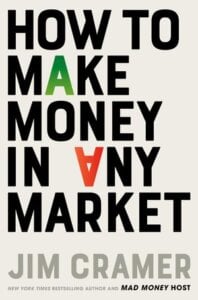
Extra controversial is Jim Cramer’s Tips on how to Make Cash in Any Market. I do know it’s modern for some mainstream monetary journalists to disparage the long-time host of Mad Cash and in-house stock-picking guru on Squawk on the Road. I by no means watch him on TV (MSNBC) however usually hearken to his podcasts whereas strolling or on the gymnasium, normally at 1.5x pace and skipping over interviews with the CEOs of extra speculative shares I’ve no real interest in. Cramer’s critics are typically diehard indexers who swear it’s not possible to constantly choose shares and “beat” the market over the long term. I are inclined to aspect with them, however extra on that beneath.
Article Continues Beneath Commercial
X
Clearly, Cramer begs to vary, usually trotting out testimonials from Nvidia millionaires who purchased that spectacular synthetic intelligence (AI) chip inventory the second he named his canine after it (sadly now deceased). Cramer devotes a complete chapter to that decision, which he mentions each probability he will get. I did purchase that inventory too, though I used to be too late and risk-averse to wager the farm sufficient to alter my life with it.
What his critics could not notice is that even Cramer believes in indexing at the very least 50% of a portfolio. Actually, he tells newcomers to shares that their first $10,000 (US) ought to go in an S&P500 index fund. Laborious to argue with that.
The place I half methods is his e-book’s advice of holding simply 5 shares for the 50% of a portfolio that’s not listed. That may imply holding round 10% of your whole portfolio in every such inventory, which is far more concentrated than most traders would countenance. A lot of the e-book goes into how to decide on the form of secular progress shares he prefers, with the assistance of recent AI instruments like ChatGPT, Grok, and all the remainder.
I used to surprise about his present’s common section, Am I diversified?, the place readers submit their 5 picks for Cramer’s consideration. I’d be surprized if there may be an investor anyplace whose portfolio is that concentrated. Even Cramer’s much-cited Charitable Belief holds many greater than 5 shares.
Canada’s finest dividend shares
How not to take a position
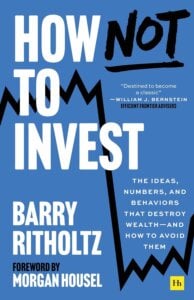
This leads me to the third e-book I ordered from Amazon, not too long ago reviewed by Michael J. Wiener of the Michael James on Cash weblog: Barry Ritholtz’s e-book How To not Make investments. Cramer cynics would possibly quip that may have been a greater title for Tips on how to earn a living in any market had it not already been taken by Ritholtz; Cramer has in spite of everything famously impressed some ETF corporations to offer “reverse Cramer” funds that quick his main lengthy suggestions.
Ritholtz’s e-book clocks in at virtually 500 pages however is sort of readable. It has attracted a number of testimonials starting from William Bernstein (“Destined to turn out to be a traditional.”) to DFA’s David Sales space, Shark Tank’s Mark Cuban and creator Morgan Housel, identified by way of The Motley Idiot, and who penned the foreword.
Ritholtz organizes his e-book in 4 elements: Unhealthy Concepts, Unhealthy Numbers, Unhealthy Habits, and Good Recommendation. Whereas Cramer tempts us into particular person stock-picking, Ritholtz reminds us that few can do it nicely; nor can most of us efficiently pull off market timing. He devotes a good bit of house to how badly some pundits’ predictions have panned out prior to now. I used to be left with a renewed appreciation for the advantages of indexing, definitely for the core of portfolios if not for his or her entirety. As he places it: “Index (largely). Personal a broad set of low-cost fairness indices for the perfect long-term outcomes.” He lists 5 benefits to indexing: decrease prices and taxes, you personal all of the winners, higher long-term efficiency, simplicity and fewer dangerous behaviour.
Luckily, peculiar traders have many benefits over the professionals, similar to not having to benchmark in opposition to indices or fear about traders who promote a fund, the flexibility to maintain prices low, and in principle a for much longer time horizon. However the clincher is that “indexing offers you a greater probability to be ‘much less silly.’”

