


Over the previous few years, many individuals have been on the lookout for alternate options to the 60/40 portfolio (a portfolio allocation of 60 p.c equities/40 p.c mounted earnings)—and for good motive. The Fed’s large intervention to decrease rates of interest made the 40 p.c allocation to mounted earnings within the 60/40 portfolio a lot much less engaging. With inflation reaching ranges we haven’t seen in a long time and the Fed set to push rates of interest larger, folks have been questioning whether or not mounted earnings nonetheless supplies the safety of principal that many traders are on the lookout for. The Bloomberg U.S. Mixture Bond Index’s worst quarter in additional than 20 years has actually elevated this concern. This ache, nevertheless, has put mounted earnings in a a lot more healthy place going ahead, with larger beginning yields capable of cushion traders from additional declines in value.
Why Use the 60/40 Portfolio?
Within the context of a 60/40 portfolio, mounted earnings is supposed to decrease the volatility of an all-equity portfolio whereas nonetheless permitting the investor to hunt an inexpensive price of return. In the long term, equities ought to outperform mounted earnings, so if progress was the one long-term concern, traders would find yourself with equity-only portfolios. For a lot of traders, although, volatility can also be a priority, so mounted earnings performs a big half within the portfolio.
That is why the 60/40 portfolio grew to become a preferred and balanced investing technique. However when charges fell to very low ranges, we noticed that mounted earnings traders had been involved with two issues:
-
Portfolios wouldn’t generate excessive sufficient returns.
-
There was the next danger of charges rising than falling, so mounted earnings wouldn’t present the identical draw back safety as prior to now.
This led to some traders implementing a number of completely different methods as a way to tackle these issues.
60/40 Alternate options
To deal with low return expectations, traders could have adjusted their 60/40 allocation to incorporate extra equities, moved into extra illiquid merchandise like personal fairness or personal credit score, or adjusted their 40 p.c allocation to incorporate higher-risk areas of the mounted earnings market. Every of those choices has its trade-offs, however all of them add danger to the portfolio. This assumed that the investor might have taken on that danger or that the chance of these asset courses wasn’t a priority with the help of fiscal and financial coverage.
For traders fearful that mounted earnings wouldn’t defend on the draw back, they might have moved into bonds with shorter maturities to guard in opposition to rising charges, used derivatives to assist defend in opposition to a market downturn, or added commodities to assist hedge in opposition to rising inflation. Trying forward, every choice has its drawbacks, so conventional mounted earnings could present higher relative worth than these alternate options.
Getting Again to Impartial
Each methods listed above provide instruments to handle sure market circumstances and supply an argument for making adjustments to your allocation when market circumstances change. However portfolios ought to have a goal allocation that may be met below “regular” circumstances. Whereas each fairness and stuck earnings suffered in the course of the first quarter, a balanced 60/40 strategy should make sense as a reasonably aggressive portfolio for some traders. The equities can present upside potential, whereas mounted earnings might help defend on the draw back whereas nonetheless providing the possibility for a constructive yield.
Each equities and bonds fell within the first quarter as actual yields and inflation expectations rose; this was an unusual mixture since rising actual yields can be anticipated to gradual inflation. The chart beneath is one in every of my favorites to indicate what degree of curiosity you’ll be able to anticipate after inflation. The white line is the 10-year Treasury, the blue line represents 10-year inflation expectations, and the underside panel reveals the distinction, which represents the actual price of curiosity.
Within the backside panel, it’s obvious that actual rates of interest are near zero and really near pre-pandemic ranges. Trying on the elements of actual charges, we see that inflation expectations (the blue line) are the very best they’ve been prior to now 10 years, whereas nominal charges are lower than 50 bps from their 10-year excessive, a degree that was maintained solely briefly earlier than the pandemic. This price spike is probably going inflicting many to query whether or not the conservative investments they’ve been investing in are literally conservative.
The pace at which charges rose triggered the ache within the first quarter, however it is going to be tough for the market to repeat that spike provided that it has priced in a big variety of Fed price hikes. Whereas it’s actually attainable for the Fed to turn into much more hawkish and inflation to stay stubbornly excessive, these dangers are beginning to be balanced out by the opportunity of a recession or a slowdown in progress.
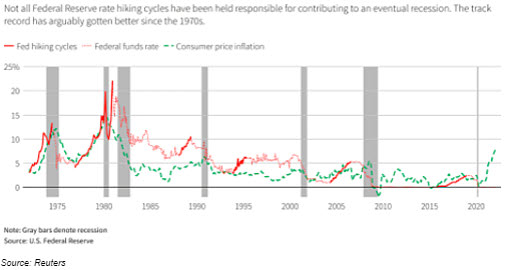
One other concern is that the Fed received’t be capable of engineer a delicate touchdown (i.e., convey down inflation with out inflicting a recession). Trying again, you’ll be able to see within the graph above that recessions have adopted mountain climbing cycles a number of occasions, so this might be a state of affairs the place mounted earnings may profit. However, there have been constructive examples of sentimental landings as effectively, resembling in 1994 (when the Fed doubled rates of interest in simply 12 months) and the newest cycle beginning in 2016. With corporations and shoppers in nice form, a delicate touchdown is an efficient chance and one the place equities might carry out effectively, which might assist offset any potential weak point of mounted earnings.
Trying Ahead, Not Backward
The advantages of a 60/40 portfolio are as a result of historic observe document of low correlation between bonds and equities described above, which prepares it for a broad vary of outcomes. We don’t need to solely put together for what simply occurred, particularly in a really rare state of affairs. So, whereas the alternate options to a 60/40 portfolio might be helpful instruments within the toolkit, if charges are transferring again towards impartial, as all the time, traders ought to take a long-term perspective; contemplate their funding goal, danger tolerance, and funding objectives; and determine whether or not transferring again to impartial is sensible for them.
Investments are topic to danger, together with the lack of principal. Some investments will not be applicable for all traders, and there’s no assure that any investing objective can be met.
Editor’s Word: The authentic model of this text appeared on the Unbiased Market Observer.

