

To rejoice Girls’s World Banking’s forty fifth anniversary, we’re showcasing the voices of people from around the globe who’ve formed and touched the Girls’s World Banking journey since its inception in 1979 at Fee on the Standing of Girls until right this moment.
These are tales from throughout Girls’s World Banking’s attain, from girls we serve and our clients, to allies and girls in management who’ve contributed to girls’s financial empowerment and monetary inclusion.
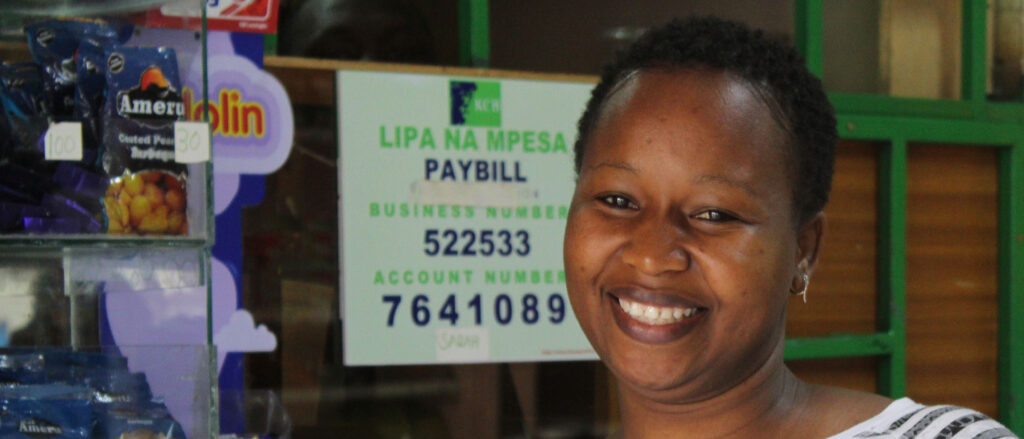
Meet Sarah Mwanthi. In 2020, she had an thrilling alternative that she simply couldn’t go up, regardless that she was already a instructor—and regardless of the worldwide pandemic. Though shifting profession paths to begin her personal enterprise wasn’t simple, throughout the peak of COVID-19 no much less, she says she nonetheless has no regrets. Now, almost 4 years later, enterprise is nice at her Kikwetu Normal Store. The truth is, she says her gross sales have elevated by a whopping 50%.
Ms. Mwanthi’s mini-mart, set at a busycorner location off of a highway bustling with distributors in Thika, Kenya, represents simply one of many few companies formally owned by girls in Kenya (31%), and demonstrates the huge gender hole in enterprise possession. Girls entrepreneurs face distinctive challenges, together with lack of collateral required for conventional loans, equivalent to land. Just one% of ladies in Kenya personal land of their names and 5–6% collectively, however contribute to 80% of the workforce in largely agricultural communities. Moreover, girls are sometimes time-poor as they’re nonetheless anticipated to tackle the bulk if not all the parenting in addition to family duties, along with operating their enterprise.
Whereas gender knowledge alliance group Data2X predicts that Kenya is on its method to totally closing its gender hole in entry to monetary providers throughout the subsequent decade, girls entrepreneurs should face business-related points on high of gender and cultural expectations. Issues round inflation, reliability of products supply and poor cashflow can pose challenges—as soon as, Ms. Mwanthi was $65 quick for a provider fee—however loans geared towards girls enterprise homeowners may also help them handle these points or, ideally, anticipate them to allow them to be managed prematurely or prevented altogether.
Girls’s World Banking Asset Administration (WAM) portfolio firm, Pezesha, is a woman-founded Kenyan fintech firm geared towards digital lending for micro, small and medium enterprises (MSMEs)—that are most frequently run by girls. In 2022, WAM’s Fund II led a funding spherical that raised $11 million to assist Pezesha scale its operations in its core markets in addition to develop into new markets inside Sub-Saharan Africa. Pezesha’s digital credit score answer gives low rate of interest loans, requires no collateral and no guarantors, asks for minimal paperwork, and supplies fast disbursement upon mortgage approval. Notably, 45% of Pezesha’s shoppers are girls. “It has actually helped me be capable to improve my money move,” Ms. Mwanthi says of working with Pezesha, which has offered her with 5 loans and elevated her credit score line from an preliminary $65 to $98. The rise in cashflow from these loans has helped her develop her enterprise by diversifying her product choices and serving a bigger buyer base. In the end, within the 4 months after receiving her loans, Ms. Mwanthi’s gross sales have elevated considerably—by 50%.
“Pezesha imeniwezesha,” she says with a smile, which loosely interprets to “Pezesha has enabled me.”
As a part of our present technique, we’ve helped present 50 million girls in rising markets – concentrating on 100 million by 2027 – entry and use of monetary merchandise and providers which are reworking girls’s lives, households, companies and communities, and driving inclusive development globally.
Assist us attain the almost billion girls nonetheless excluded from the formal monetary system. Donate now.
Discover Different Tales in Making Finance Work for Girls for 45 Years

